

By SuccessValley Editorial Team
Preparation determines whether founders earn a second meeting. An angel investor pitch succeeds or fails
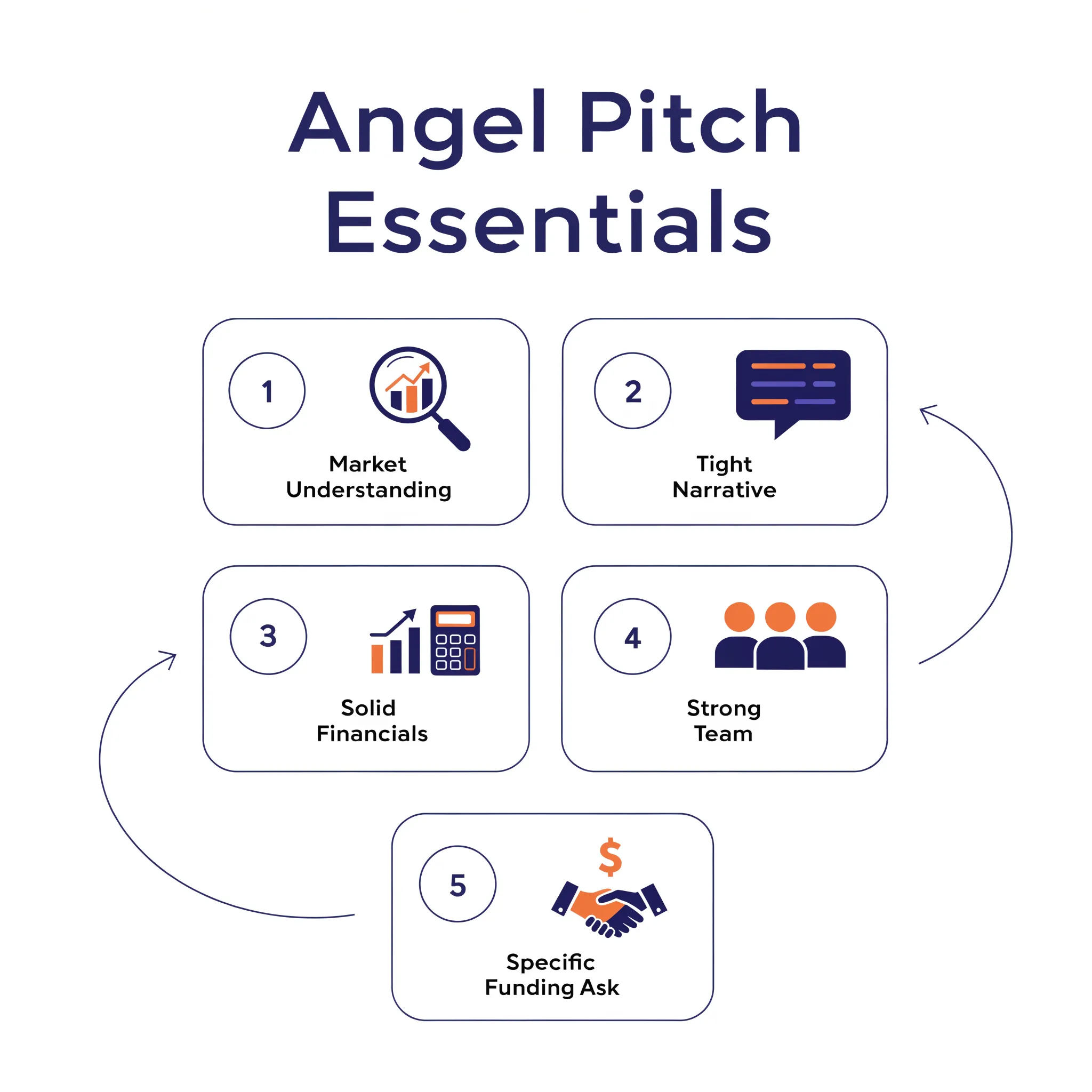
When pitching to angels, founders secure investor confidence by demonstrating clear market understanding, a tight pitch, solid financials, a strong team, and a specific funding ask. SuccessValley’s mentors and startup resources help founders refine each of these five elements before facing investors. That preparation gives a pitch the confidence and clarity it needs to become a funded venture.
Successful angel pitches combine clear market analysis, defined financials, and a confident funding ask. Founders within SuccessValley’s global network gain mentorship from experienced business leaders who refine pitch decks, validate market sizing, and prepare answers to investor questions covering team strength and growth strategy before approaching angel investors or pursuing Series A funding.
Key Takeaways
- Angels invest personal capital and decide individually, so trust in a founder’s judgment and execution ability outweighs an exhaustively engineered financial model.
- A winning angel investor pitch combines clear market understanding, a tight narrative, solid financials, a strong team, and a specific funding ask.
- Mentorship from experienced founders and business leaders exposes blind spots, stress-tests assumptions, and sharpens the pitch before it faces an angel.
- Pressure-testing the pitch within a founder community surfaces weak points and builds delivery confidence ahead of live investor meetings.
- Few companies that raise a seed round go on to reach Series A funding, which makes disciplined follow-up after a pitch as important as the pitch itself.
- After a rejected pitch, founders should request specific feedback, revise the narrative, update financial assumptions, and seek community input rather than treating rejection as final.
What Should You Prepare Before Pitching Angels?
Preparation determines whether founders earn a second meeting. An angel investor pitch succeeds or fails long before anyone opens a slide deck. Angels supply capital to early-stage businesses, usually in exchange for equity or convertible debt. Founders must understand this structure before framing any ask. Missing that distinction wastes valuable time with the wrong investor type.
Founders preparing for early stage pitching should complete these steps in order:
- Study the business model and target market until financial assumptions hold up under questioning.
- Draw on startup resources and educational materials to sharpen understanding of unit economics and growth strategy.
- Rehearse the story with mentors who have raised capital before, since experienced founders and business leaders can expose weak logic early.
- Build relationships with potential angels ahead of any funding need, since business outcomes often depend on existing trust.
- Refine the specific ask, including funding amount and use of funds, so the pitch closes with clarity.
Why does mentorship matter before an early pitch?
Mentorship exposes gaps a founder cannot see alone. Experienced founders and business leaders can stress-test assumptions, question financial projections, and flag weak positioning before an angel ever does. That feedback loop sharpens the pitch and builds confidence heading into the room.
Founders who prepare this way position their pitch to angels as a natural next step, not a rushed request.

How Do You Deliver a Winning Angel Pitch?
A winning presentation proves execution ability, builds a clear narrative, and gets tested in front of real founders before it reaches an investor’s desk. Early-stage founders who skip rehearsal often discover weaknesses only after an investor has already lost interest. The steps below outline a practical sequence for founders preparing their angel investor pitch.
- Build the narrative first. A founder’s business idea needs a story arc before it needs a slide deck, since angels evaluate individually and invest personal capital.
- Emphasize execution, not exhaustive modeling. Angels want proof that founders can build and deliver, not a financial model engineered to survive endless scrutiny.
- Pressure-test the pitch inside a community. Discussions and groups within a founder network let entrepreneurs surface blind spots before presenting live.
- Use structured support to refine the ask. A complete ecosystem beyond simple networking helps translate a raw idea into a pitch that resonates with angel expectations.
- Rehearse until delivery feels natural. Supportive communities focused on innovation and growth give founders repeated opportunities to refine weak points ahead of investor meetings.
What Do Angels Look for Differently Than VCs?
Angels assess whether a founder can execute, not whether the spreadsheet withstands infinite scrutiny. They invest their own money and decide alone, so trust in the founder’s judgment matters more than polished projections. This makes rehearsal and honest feedback loops essential parts of early stage pitching.
Where Can Founders Test Their Pitch Before Presenting?
Founders can test a pitch inside groups and discussion threads built for entrepreneurs facing similar fundraising challenges. Peer feedback exposes gaps in the narrative long before an angel ever sees the deck.

What Mistakes Should You Avoid After Pitching?
Silence after a meeting kills momentum fastest. Founders who skip follow-up, ignore feedback, or treat rejection as final lose ground that competitors gain. Companies that raise a seed round rarely reach Series A funding. That reality shows how much a strong angel investor pitch and disciplined follow-through actually matter.
Why Do Founders Fail to Improve After a Rejected Pitch?
Many founders assume a rejected pitch signals a dead end rather than a diagnostic tool. Without outside perspective, they repeat the same framing, financials, or delivery errors in the next meeting. Structured mentorship from experienced founders and business leaders helps close that gap by pinpointing exactly where the pitch faltered and how to fix it before the next attempt.
Common missteps after pitching include:
- Failing to request specific feedback from the investor
- Abandoning the pitch narrative instead of revising it
- Neglecting to update financial assumptions after new questions surface
- Isolating instead of seeking community input
A supportive, growth-focused community atmosphere matters here. It gives founders practicing early stage pitching the encouragement to refine their approach rather than walk away discouraged after one difficult conversation.
Conclusion
Successfully pitching to angel investors requires strategic preparation, a compelling narrative, and genuine conviction in the venture’s potential. Founders who master investor communication, demonstrate market comprehension, and articulate a clear path to profitability put themselves in a strong position to secure capital and partnerships for growth. SuccessValley equips founders with the mentorship, educational resources, and community connections needed to refine their pitch and navigate investor relations with confidence, so ambitious ideas have a real path to funding.
Frequently Asked Questions
What do angel investors look for in a pitch?
Angel investors evaluate a founder’s ability to execute, not just financial projections. Because angels invest personal capital and decide individually, they weigh clear market understanding, a confident and specific funding ask, a strong founding team, and a tight, well-rehearsed narrative more heavily than an exhaustive financial model.
How is pitching to angels different from pitching VCs?
Angels invest their own money and make decisions independently, so trust in the founder’s judgment carries more weight than polished spreadsheets. Venture capitalists typically involve committee review and heavier financial scrutiny. This distinction shapes how early-stage founders should frame and rehearse an angel investor pitch.
How should founders prepare before pitching angel investors?
Founders should study their business model and target market, sharpen their understanding of unit economics and growth strategy, rehearse with mentors who have raised capital before, build relationships with potential angels ahead of any funding need, and refine a specific funding ask before entering the room.
Why does mentorship improve an angel investor pitch?
Mentorship from experienced founders and business leaders exposes gaps a founder cannot see alone. Mentors can stress-test financial assumptions, question positioning, and flag weak logic before an angel does, which sharpens the pitch and builds genuine confidence heading into the meeting.
What should founders do after a rejected angel pitch?
Founders should request specific feedback from the investor, revise the pitch narrative rather than abandon it, update financial assumptions based on new questions raised, and seek input from a founder community instead of isolating. Treating rejection as diagnostic information, not a final verdict, keeps momentum toward the next opportunity.
