
By SuccessValley Editorial Team · Updated 2026-08-17
The Business Model Canvas, developed by Alexander Osterwalder, organizes your business strategy across 9 building blocks: Customer Segments, Value Propositions, Channels, Customer Relationships, Revenue Streams, Key Resources, Key Activities, Key Partners, and Cost Structure. Fill each block systematically, starting with Customer Segments, to map your entire business model on one page.
The Business Model Canvas works as a one-page visual framework containing nine connected boxes that map how all parts of a business work together. Filling one in takes between 15 and 30 minutes. Start by identifying your customer segments and value propositions, then work through key resources, revenue streams. Cost structures to build a complete strategic picture.
Using the Business Model Canvas starts with mapping nine core building blocks. Including customer segments, value propositions, and revenue streams — onto a single one-page visual framework. Created by Alexander Osterwalder and Yves Pigneur, the tool helps entrepreneurs identify opportunities, address challenges. Align strategy before committing resources to execution.
What Is the Business Model Canvas and Why Use It?
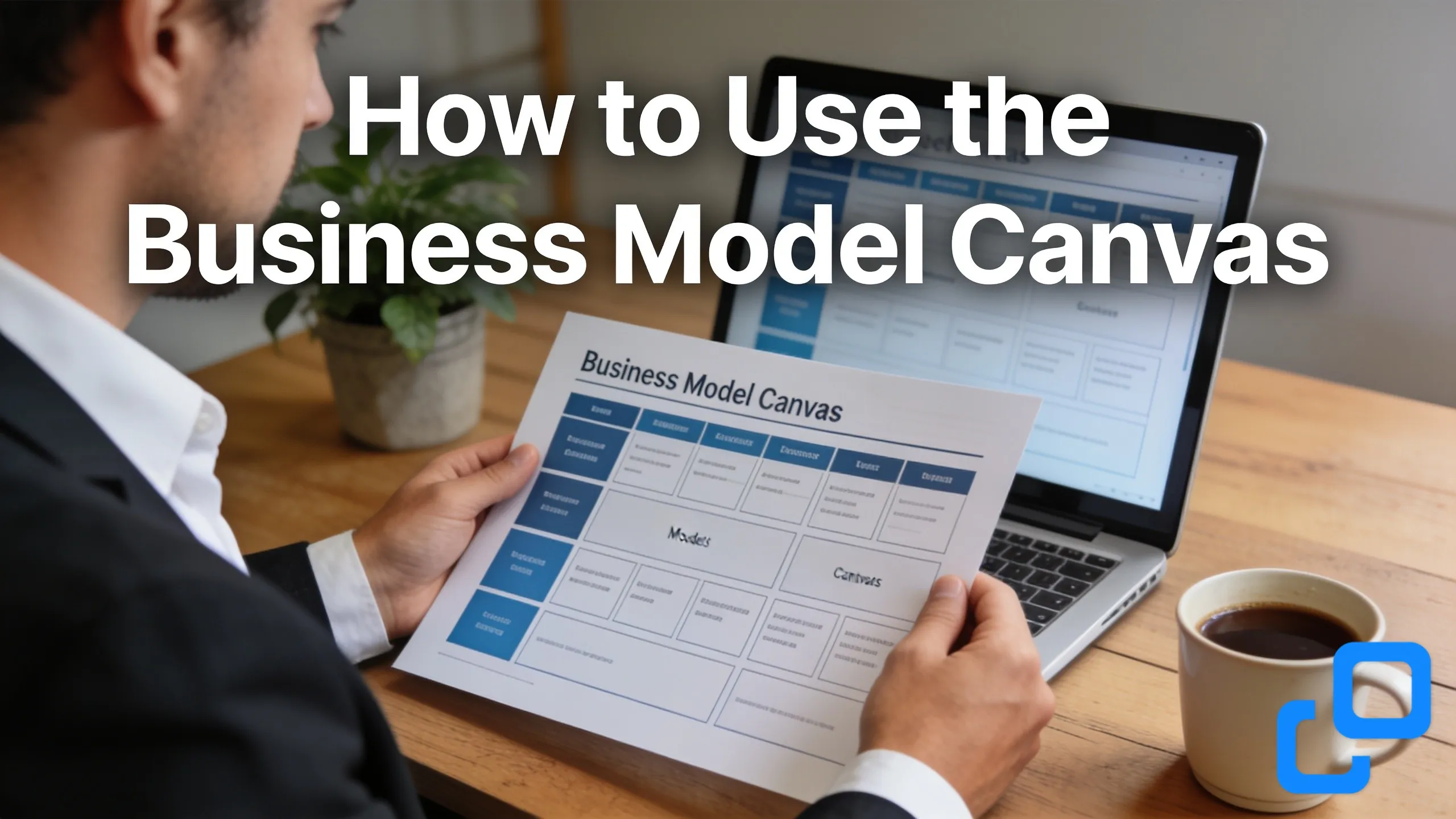
The business model canvas is a one-page visual framework that captures the essential elements of a business plan on a single structured page. Entrepreneurs and managers use the canvas to identify opportunities, address challenges. Map out how a business creates and delivers value — all without wading through complex documents.
The BMC organizes a business around nine fundamental building blocks. Each block represents a core component of value creation, from revenue streams to key partnerships. Together, the nine components give founders a complete strategic picture at a glance.
How long does it take to fill in a Business Model Canvas?
Completing a Business Model Canvas takes between 15 and 30 minutes. That speed makes the tool practical for early-stage planning sessions, team workshops, and rapid idea testing alike.
What are the core building blocks of the Business Model Canvas?
The nine building blocks include the value proposition — what a business offers that solves a real problem. And customer segments, which define exactly who the business serves. The remaining blocks cover resources, channels, revenue, costs, and partnerships, forming an interconnected system.
Platforms like SuccessValley provide entrepreneurs with startup resources. Educational materials that support this kind of structured business planning, helping founders move from blank canvas to actionable strategy.

How Do You Fill In Each Canvas Block?
Filling in a business model canvas starts with a single, accessible surface. A whiteboard, napkin, or notepad works equally well. Entrepreneurs work through nine interconnected blocks, moving from customer-facing elements inward toward operational and financial foundations.
Before starting, gather key stakeholders from across the organization. The canvas fosters collaborative innovation by giving different departments a shared language to contribute their expertise. Meaning finance, marketing, and product teams can all work from the same one-page framework without confusion.
Follow these steps to complete each block:
-
Define customer segments — Identify the distinct groups the business serves. Segment by behavior, need, or demographic to keep targeting precise.
-
Articulate the value proposition — State clearly what problem the business solves for each segment and why the solution is meaningfully different from alternatives.
-
Map channels — Determine how the business reaches and delivers value to each customer segment.
-
Establish customer relationships — Decide what type of relationship each segment expects, from self-service to dedicated support.
-
Identify revenue streams — Document how the business earns income from each segment.
-
List key resources — Record the assets required to deliver the value proposition.
-
Define key activities — Outline the critical actions the business must perform.
-
Identify key partners — Note external organizations that reduce risk or supply resources.
-
Calculate cost structure — Map the major costs that the business model generates.
Why Does the Order of Blocks Matter?
Starting with customer segments and the value proposition anchors every downstream decision in real market need. Teams that reverse this order — building cost structures before understanding customers — routinely misalign resources with revenue opportunity.
How Does SuccessValley Help Entrepreneurs Refine Their Canvas?
SuccessValley provides business development courses and startup validation tools designed to help entrepreneurs stress-test each canvas block against real-world conditions. The platform’s mentorship community supports founders in developing the strategic mindset needed to translate a completed canvas into a scalable business.

How Do You Apply and Refine Your Canvas Over Time?
The business model canvas functions as a living strategic blueprint, not a one-time document. Organizations embed the canvas into regular planning cycles to keep strategy aligned with real-world conditions.
How Do Entrepreneurs Test What’s on Their Canvas?
Entrepreneurs validate canvas assumptions through customer feedback and market research. Gathering direct input from customer segments exposes gaps between assumed and actual needs. Refining the canvas based on that data sharpens the overall strategy.
When Should a Team Revisit the Canvas?
Strategic conditions shift. Teams that revisit the canvas during each planning cycle catch misalignments early — before those gaps become costly. Updating the value proposition in response to market signals keeps the business model competitive.
Follow these steps to apply and refine the canvas systematically:
-
Map the current state — complete all nine canvas blocks with the team.
-
Identify assumptions — flag every block that relies on unverified beliefs.
-
Gather evidence — collect customer feedback and conduct market research.
-
Update the canvas — revise blocks where evidence contradicts assumptions.
-
Connect with peers — engage a global network of founders, investors, and business leaders to exchange ideas and stress-test the revised model.
The Business Model Canvas transforms abstract business thinking into a clear, actionable blueprint. By working through each building block — from customer segments to revenue streams. You develop a sharper understanding of how your venture creates, delivers, and captures value. Treat it as a living document, revisiting and refining it as your business evolves. The entrepreneurs who leverage this tool consistently are the ones who build with intention, adapt with confidence, and scale with purpose.
