
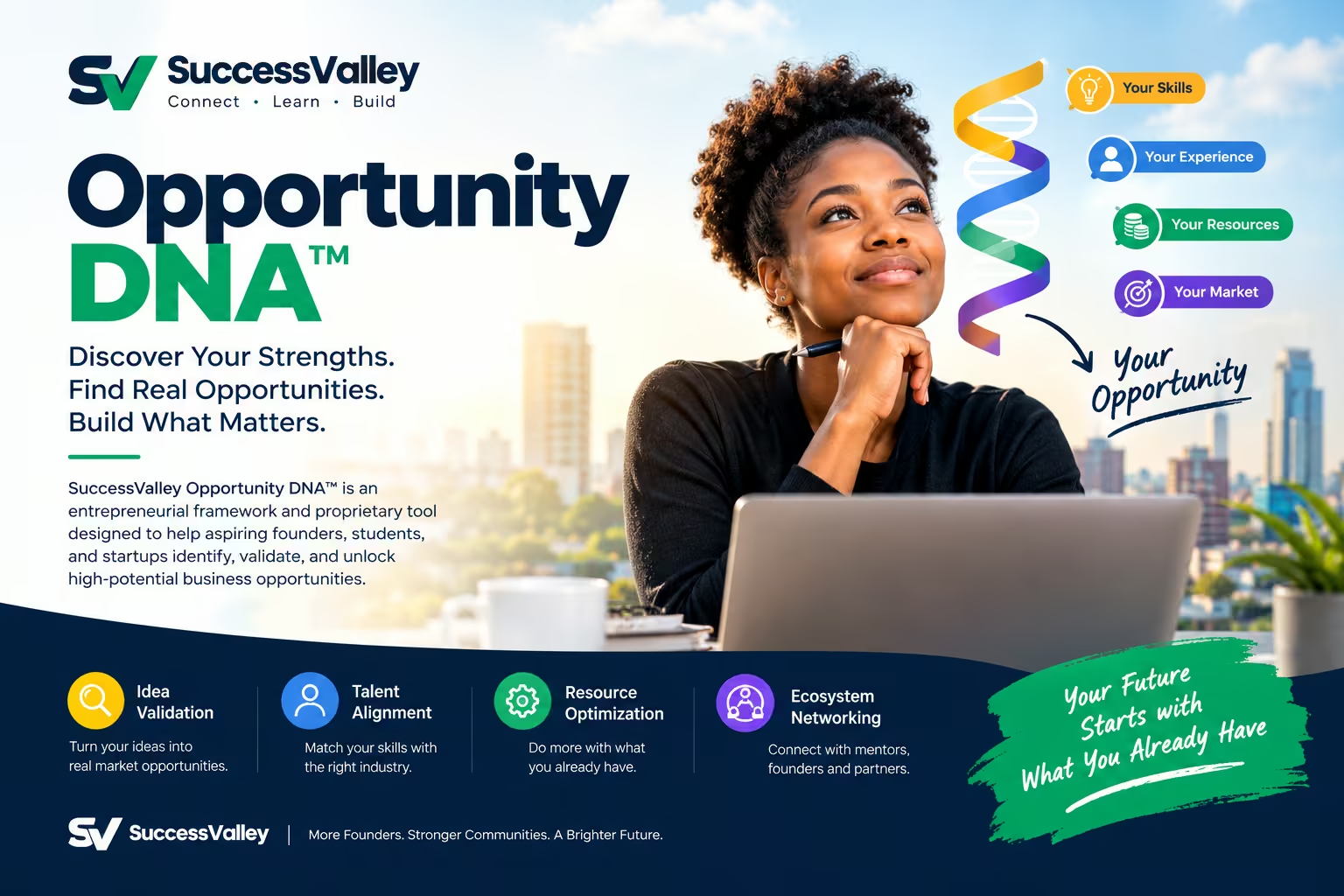
SuccessValley Opportunity DNA™ is an entrepreneurial framework and proprietary tool designed by SuccessValley to help aspiring founders, students, entrepreneurs and startups identify, evaluate, validate and unlock high-potential business opportunities.
It is built around a simple idea:
You may already have more of what you need to start a business than you realize.
Instead of beginning with “What business should I start?”, Opportunity DNA™ begins with:
“What do I already have, what problems can I solve, and where could those strengths create real value?”
1. What Is Opportunity DNA™?
Opportunity DNA™ is a structured entrepreneurial diagnostic.
It looks at the relationship between:
YOU + YOUR RESOURCES + YOUR EXPERIENCE + YOUR MARKET + YOUR OPPORTUNITY
The system helps transform those inputs into a practical opportunity map.
Rather than giving everyone the same generic business ideas, Opportunity DNA™ is designed to produce recommendations based on the individual’s circumstances.
The framework examines four major dimensions
1. Talent Alignment
What are you naturally good at?
What skills have you developed?
What experience do you already possess?
2. Market Opportunity
What problems exist around you?
Who experiences those problems?
Are people already spending money to solve them?
3. Resource Optimization
What can you start with?
Your time, money, network, knowledge, technology, equipment, audience and relationships can all become entrepreneurial resources.
4. Ecosystem Connection
Who can help you move from an idea to execution?
That could include:
- Founders
- Coaches
- Mentors
- Technical experts
- Customers
- Strategic partners
- Investors
- Industry professionals
2. Who Should Use Opportunity DNA™?
Opportunity DNA™ is particularly useful for:
Aspiring entrepreneurs
You want to start a business but don’t know what opportunity is right for you.
Students
You want to turn your knowledge, skills or interests into a business or income opportunity.
First-time founders
You have an idea but need to determine whether it is worth pursuing.
Existing entrepreneurs
You want to discover new products, services, markets or revenue opportunities.
Startup teams
You want to identify where your team’s strengths provide a competitive advantage.
Professionals
You want to turn your experience into consulting, products, services or a new venture.
Local entrepreneurs
You want to identify problems in your community and build solutions around real local demand.
3. The Opportunity DNA™ Philosophy
Opportunity DNA™ is based on a simple principle:
Don’t start by building. Start by understanding.
Many entrepreneurs make the same mistake:
IDEA → BUILD → LAUNCH → HOPE
Opportunity DNA™ encourages a different approach:
DISCOVER → VALIDATE → CONNECT → GET HELP → BUILD
This distinction is important.
A great idea is not automatically a great business.
A business opportunity becomes stronger when:
- There is a real problem.
- A specific group of people experiences the problem.
- Those people care about solving it.
- A solution can be delivered.
- Customers are willing to pay.
- You have a realistic way to reach those customers.
4. How to Use Opportunity DNA™
Using the tool should take only a few minutes.
When you begin the assessment, answer the questions honestly rather than trying to give the answers you think the system wants.
The quality of your results depends on the quality of your inputs.
Step 1: Identify Your Skills
Think about things you can actually do.
Examples:
- Programming
- Marketing
- Sales
- Graphic design
- Writing
- Video production
- Accounting
- Teaching
- Research
- Project management
- Public speaking
- Photography
- Engineering
- Business development
- Customer service
Don’t underestimate everyday skills.
For example:
Someone who is exceptionally good at organizing people may have:
Project management + coordination + communication
Those capabilities could potentially support a business.
5. Step 2: Enter Your Experience
Your experience gives Opportunity DNA™ context.
Consider:
- Jobs you’ve held
- Businesses you’ve operated
- Projects you’ve completed
- Industries you’ve worked in
- Problems you’ve solved
- Communities you’ve served
- Volunteer experience
- Freelance work
- Academic projects
Example
A student who has spent two years helping small businesses manage Instagram accounts has more relevant experience than they may realize.
Their experience could indicate an opportunity around:
small-business content + social media + customer acquisition.
6. Step 3: Identify Your Assets
This is one of the most important parts of Opportunity DNA™.
An asset is something you already possess that could help you create value.
Assets can include:
- Laptop
- Smartphone
- Website
- Audience
- Social media following
- Email list
- Professional network
- Community
- Equipment
- Industry knowledge
- Certifications
- Existing customers
- Relationships
- Intellectual property
- Physical location
- Personal brand
- Access to a particular market
Your network can be an asset.
For example:
Someone who knows:
- 20 restaurant owners
- 10 software developers
- 15 teachers
- 5 investors
may have access to opportunities that another entrepreneur does not.
7. Step 4: Tell the System What You Are Interested In
Your interests matter because entrepreneurship requires persistence.
Consider:
- Industries you enjoy
- Problems you care about
- Topics you can talk about for hours
- Communities you understand
- Things you enjoy learning about
However, don’t confuse interest with market demand.
Opportunity DNA™ uses your interests as one signal—not as proof that a business will succeed.
8. Step 5: Tell Us About Your Resources
Opportunity DNA™ considers practical constraints.
Time
How much time can you dedicate?
- A few hours per week
- Part-time
- Full-time
Capital
How much can you realistically invest?
Starting with $100 is fundamentally different from starting with $10,000.
The goal is not to judge your resources.
The goal is to find an opportunity that fits your current reality.
9. Step 6: Complete the Assessment
Once your information is entered, Opportunity DNA™ analyzes the combination of your answers.
The system looks for patterns between:
- Skills
- Experience
- Assets
- Interests
- Resources
- Market potential
The result is your personalized Opportunity DNA™ profile.
10. Understanding Your Results
Your report is not simply a list of business ideas.
It is an entrepreneurial decision framework.
Your report contains several important sections.
A. Your Opportunity Profile
This describes the entrepreneurial characteristics revealed by your answers.
It answers:
What type of opportunity may fit you best?
For example:
The Technical Builder
You may be strongest when solving technical problems and creating scalable products.
Or:
The Market Connector
Your network, communication skills and industry relationships may make distribution and partnerships your strongest advantage.
Or:
The Expertise Entrepreneur
Your professional knowledge may be better suited to a specialized service, consulting business or knowledge product.
11. Your Top Opportunities
Opportunity DNA™ identifies opportunities that align with your particular combination of resources and capabilities.
For each opportunity, ask:
What problem does this solve?
Who is the customer?
Why might I be well-positioned to solve it?
What resources would I need?
How could I test it cheaply?
What evidence would prove that it is worth pursuing?
12. Opportunity Score™
The Opportunity Score™ is intended as a decision-support signal, not a guarantee of business success.
A higher score indicates stronger alignment between the opportunity and the information you provided.
Use it to prioritize what to investigate first.
Do not interpret:
90/100 = guaranteed successful business
Instead interpret it as:
90/100 = strong candidate for validation.
The real test happens in the market.
13. Hidden Asset Finder™
One of the most valuable parts of Opportunity DNA™ is discovering resources you may have overlooked.
For example:
You may think:
“I don’t have money to start a business.”
But your assessment may reveal:
- Industry experience
- Existing customers
- An audience
- Technical skills
- Professional relationships
- Specialized knowledge
Those resources can sometimes compensate for limited financial capital.
Ask yourself:
What do I have access to that someone else would have to spend years building?
That could be your competitive advantage.
14. Don’t Build This
Opportunity DNA™ also identifies potential paths that may not fit your current situation.
This is important.
Entrepreneurship isn’t only about discovering what to build.
It is also about discovering what not to build.
For example:
If you have limited capital and limited time, a capital-intensive business may be inappropriate as your first experiment.
If you have strong technical skills but no validated customer problem, spending six months building software may be premature.
If you have an audience, creating another generic digital product without understanding their needs may waste an existing advantage.
15. Your 30-Day Opportunity Experiment
This is where Opportunity DNA™ moves from diagnosis to action.
Do not immediately build a complete business.
Instead, run an experiment.
Days 1–3
Define:
One customer.
One problem.
One proposed outcome.
Days 4–7
Talk to potential customers.
Aim for approximately:
10 meaningful conversations.
Ask:
- How are you solving this problem today?
- What does it cost you?
- How frequently does it happen?
- What have you already tried?
- What would a better solution look like?
Days 8–10
Create a minimum offer.
This could be:
- Prototype
- Landing page
- Consulting package
- Service package
- Demo
- Sample product
- Workshop
- Pilot program
Days 11–15
Reach potential customers.
Don’t simply ask:
“Do you like my idea?”
Ask whether they will:
book, sign up, test, refer, or pay.
16. Days 16–30: Test the Market
Now collect evidence.
Measure:
- Conversations
- Leads
- Sign-ups
- Demonstrations
- Trial users
- Purchases
- Pre-orders
- Referrals
- Objections
At the end of the experiment, make one of three decisions:
BUILD
There is meaningful evidence of demand.
MODIFY
The problem appears real, but your solution, customer segment or business model needs adjustment.
ABANDON
The evidence does not justify continuing with the current opportunity.
Abandoning an unvalidated idea is not failure.
It can be one of the smartest entrepreneurial decisions you make.
17. Finding Your First $1,000
Opportunity DNA™ also helps you think about your first revenue milestone.
Your first $1,000 does not necessarily come from launching a large company.
It might come from:
- Three $350 clients
- Ten $100 customers
- Twenty $50 customers
- One $1,000 implementation
- Five $200 consulting packages
- A combination of services and digital products
The objective is to discover:
What can someone realistically pay me for today based on the value I can already provide?
18. People You Should Meet
Entrepreneurship shouldn’t be done in isolation.
Opportunity DNA™ therefore identifies the types of people who could help you move forward.
Depending on your profile, that could include:
Customers
People experiencing the problem.
Founders
People who have already built businesses.
Coaches and mentors
People who can help you improve your decision-making.
Technical partners
Useful when the opportunity requires product or software development.
Marketing and sales experts
Useful when distribution is your biggest challenge.
Investors
Relevant when capital is actually required for the next stage.
Strategic partners
Organizations or individuals who can provide distribution, credibility, resources or access to customers.
19. Your Recommended Coach
Opportunity DNA™ may recommend a type of coach based on your strongest development need.
For example:
Marketing → Marketing & Sales Coach
Programming → Product / SaaS Coach
Finance → Finance & Fundraising Advisor
Design → Product & Brand Coach
General business development → Business Growth Coach
The recommendation is not meant to replace your judgment.
It is intended to help you identify the kind of expertise you should seek next.
20. Opportunity DNA™ and the SuccessValley Ecosystem
Opportunity DNA™ is designed to be the beginning of an entrepreneurial journey—not the end.
The broader pathway is:
DISCOVER
Understand your entrepreneurial strengths and opportunities.
↓
VALIDATE
Test whether customers actually want the solution.
↓
CONNECT
Meet founders, customers, experts and potential partners.
↓
GET HELP
Find coaches, mentors and specialists.
↓
BUILD
Turn validated opportunities into businesses.
This is where Opportunity DNA™ fits within the wider SuccessValley ecosystem.
21. How Students Can Use Opportunity DNA™
Students don’t need to wait until graduation to begin exploring entrepreneurship.
A student can use the framework to combine:
Education + skills + interests + community problems
For example:
A student studying accounting who understands the challenges of small businesses could investigate tools or services that help SMEs manage finances.
A computer science student could investigate software problems experienced by businesses they already understand.
A communications student could explore specialized content, media or communications services.
The goal isn’t necessarily to launch immediately.
The goal is to develop the ability to recognize opportunities.
22. How Startups Can Use Opportunity DNA™
Existing startups can use Opportunity DNA™ to examine:
Product expansion
What adjacent problem could you solve?
Customer expansion
What new customer group could benefit?
Revenue expansion
What additional revenue model fits your capabilities?
Resource optimization
What existing assets are underutilized?
Team alignment
Where are your strongest capabilities?
23. How Local Entrepreneurs Can Use It
Opportunity DNA™ is especially relevant to entrepreneurs building in emerging markets.
The strongest opportunity may not always be a globally famous technology trend.
Sometimes it is a local problem that has not been solved well.
Look around you.
Ask:
- What do people struggle with every week?
- What businesses operate inefficiently?
- What services are difficult to access?
- Where are people losing time?
- What processes remain manual?
- What products are expensive or unavailable?
- What local businesses need better technology?
- What communities are underserved?
Then combine those observations with your own capabilities.
24. What Opportunity DNA™ Does NOT Do
Opportunity DNA™ does not guarantee:
- Business success
- Investment
- Customers
- Revenue
- Funding
- Product-market fit
It is not a substitute for:
- Customer research
- Market research
- Financial analysis
- Legal advice
- Professional advice
- Actual market testing
Its purpose is to help you make better entrepreneurial decisions faster.
25. The Golden Rule
Remember this:
Your Opportunity DNA™ result is a starting point, not a final answer.
Your report tells you:
“This may be worth investigating.”
The market tells you:
“This is worth building.”
That’s why the most important step after receiving your report is:
VALIDATE.
26. Your Opportunity DNA™ Action Checklist
After completing the assessment:
☐ Read your Opportunity Profile
☐ Review your three opportunities
☐ Identify your strongest opportunity
☐ Examine your Hidden Assets
☐ Read your “Don’t Build This” recommendations
☐ Identify your target customer
☐ Define the problem
☐ Speak with 10 potential customers
☐ Create a minimum offer
☐ Test demand
☐ Track responses
☐ Decide: BUILD, MODIFY or ABANDON
☐ Connect with relevant founders
☐ Find the right coach/mentor
☐ Continue your entrepreneurial journey with SuccessValley
27. The SuccessValley Opportunity DNA™ Mindset
Don’t ask:
“What business is everyone else starting?”
Ask:
“What problem can I solve unusually well because of what I already know, who I know, what I have access to, and what my market needs?”
Don’t ask:
“How can I build this faster?”
Ask:
“How can I validate this before I invest heavily?”
Don’t ask:
“Can I build this alone?”
Ask:
“Who should I meet to make this opportunity stronger?”
And most importantly:
Don’t build in isolation.
Your skills may start the journey.
Your market validates the opportunity.
Your network accelerates the journey.
And the right support can help turn an idea into something real.
Your next step
Take the SuccessValley Opportunity DNA™ assessment
Discover your strengths.
Uncover hidden assets.
Identify potential opportunities.
Validate before you build.
Connect with the people who can help.
Discover → Validate → Connect → Get Help → Build
SuccessValley Opportunity DNA™
Find the opportunity hiding inside what you already have.
